
The great philosopher Voltaire said:
“If you would discuss with me, define your terms.”
Let’s heed his advice:
Interpreting: transforming a message from the source language to the target language in spoken communication. Excellent interpretation entails changing the form (words and structure) without changing the message and its components.
Simultaneous: happening at the same time, coinciding in time.
Simultaneous Interpreting: a technique where the speaker is not pausing, and the very gifted and trained (let us hope) interpreter is rendering the speaker’s thoughts into the language of choice at the “same” time.
Simultaneous Translation: no difference from simultaneous interpreting. Today, translation is used for written texts while interpreting – for spoken communication. In time past, translation as a term encompassed both concepts, and today many people still use it that way. Hence, the terms are interchangeable. Someone super pedantic might frown upon “simultaneous translation” for reasons described, but in truth, there is no difference.
Chuchotage – a type of simultaneous interpretation where no equipment is used and the interpretation is done by whispering into the client’s ear (from the French word chuchotage, “whispering”)
***
Not to confuse the reader, but to offer a curious viewpoint – the action of interpreting is, indeed, simultaneous, but the message does not actually get conveyed simultaneously because the interpreter is following the speaker at a distance (lagging in time) to fully understand the thought.
For example, the speaker says: “Ladies and Gentlemen, what a true pleasure to welcome you to this luminous and historic hall today. Let us begin…”
The interpreter needs to hear the thought to say anything meaningful at all, so he or she waits, biding their time and starts speaking and interpreting “Ladies and Gentlemen” when the speaker is already at “Let us begin.”
Of course, the interpreter could start earlier, but then there is a risk the interpretation would be choppy as the interpreter still doesn’t have the full thought. The interpreter could also start later, but then there is a risk he or she would lose the train of thought (trains travel fast, mind you).
Therefore, one of the skills required in simultaneous interpretation would be the ability to gauge that distance, that time lag known as décalage – not to be confused with décolletage! – and to adjust accordingly in various contexts (décalage means “gap” in French).
Décalage varies based on language as well: for example, in German the verb often comes at the end of the sentence; hence, to interpret meaningfully into German, one has to wait for the verb. But a standard décalage is between 2-5 seconds.
TO DISCUSS YOUR INTERPRETATION NEEDS, PLEASE GET IN TOUCH

Why Simultaneous Interpretation?
The clear advantage of simultaneous (short for simultaneous interpretation/translation) is that it is, indeed, instant, and does not require any additional time, in comparison with consecutive interpretation (when the speaker pauses for the interpreter).
It has other advantages, but that is the most obvious.
Example:
Imagine a lecture or presentation given and attended by non-English speakers of five other languages – let us say, Spanish, Hmong, Russian, Somali, and Vietnamese.
The task at hand is to make sure everyone understands the speaker. If we were doing consecutive interpretation, five interpreters would have to interpret one after the other and the meeting would take roughly six times as long. (The interpreters could not all speak at once after the speaker, as they’d be speaking over each other and there would be pandemonium in the room).
Now, with simultaneous, the speaker does not worry about stopping and continues on just like they would if they were speaking to English speakers only.
The interpreters are working using the simultaneous interpretation mode, so this time they’re not speaking over each other, as all their clients have equipment (receivers), so it is enough for each interpreter to whisper, and the equipment does the trick.
Magical, isn’t it?
When Is Simultaneous Interpretation Used?
The answer here is clear: anytime the interpreter is too lazy to memorize anything…Joke. (However, there is some truth to that joke).
In truth, simultaneous is used in many contexts:
- Meetings and conferences with attendees who speak other languages
- Court proceedings
- Political and diplomatic functions
- Tours and lectures
- Much, much more
It is not necessarily prudent to use simultaneous in settings where quick exchanges are happening, like negotiations, Q and A sessions, parent-teacher conferences, etc. Although, even here a skilled interpreter can use simultaneous to interpret into at least one direction. For example, they may interpret a question from the audience consecutively and then the speaker’s answer back simultaneously. They may also interpret the question simultaneously by using chuchotage. There are many variations, but the technique is mighty useful.
TO FIND OUT IF SIMULTANEOUS INTERPRETATION IS RIGHT FOR YOUR EVENT, PLEASE GET IN TOUCH
What is the Skill Set Required for Simultaneous Interpretation?
By definition, simultaneous interpretation is done while the speaker is speaking and does not pause. Hence, the fundamental ability would be to listen (as well as hear and understand!) and speak at the same time. Without it, no simultaneous interpretation can happen.
Another ability would be to match the speaker’s speed (accelerate and decelerate as needed). Some speakers are quite slow (around 100 words per minute) while judges in immigration court sputter like automatic rifles – around 200 words per minute. A trained professional can handle both.
One has to be able to modulate not only speed, but loudness and softness as well: if one is too loud, he or she may overshadow the speaker and stop hearing the speech. If they’re too quiet, the clients may not hear. This is a skill I had to learn early on in my career.
It goes without saying that one must have a strong command of both languages, the source and the target language. Since one cannot interpret something one does not understand, the interpreter’s comprehension must be impeccable. Since one cannot fluently phrase concepts without feeling like a fish in the water in the target language, one must have an excellent command of that language.
Some people prefer to only work in one direction (for example English into Spanish) because they understand English beautifully but have a better command of Spanish. This is workable, but it is best to be able to toggle one’s mental switch and change directions: it makes one’s mind and one’s repertoire more flexible.
Navigating the seas of terminology is a crucial skill for any interpreter, including a simultaneous one. This would easily take a whole essay, not to mention a book. However, in essence, the interpreter must find their bearings in the terminology of the field they’re interpreting before the job: yet all too often, we still have to figure things out on the fly. These skills are vital, literally, as without some conversance with terminology, the interpreter’s vitals will quickly devitalize…
The interpreter’s mind must be fast and flexible as simultaneous translation leaves almost zero time for thinking, so the linguist (interpreter) must rely on their skill, their mind, and the knowledge gleaned earlier. Simultaneous interpreting is not for the faint of heart.
A true simultaneous interpreter is not only a hero of speed, but also of endurance. Per our protocols, we switch every 15-30 minutes, but that is in theory. In practice, many of us have had to work for hours on end… And even 15 minutes of fast and furious simultaneous interpreting can be taxing. Does running a 5k race in 15 minutes require endurance?
A great simultaneous interpreter must be able to catch their own mistakes and make a snap judgment if that mistake was vital and needs fixing or if it is time to move on. And, while accuracy is always of paramount importance, there is no perfect interpreter. So, one of the skills is to move on rapidly once something is missed – otherwise, the interpreter will fall behind faster than you can say “supercalifragelisticexpialidocious.”
A simultaneous interpreter must also be a rather amiable fellow because we work in a pair and with people. It takes some finesse to get along with your “partner in crime,” especially since it might be your first time ever working with them. You might also have to deal with unfair bosses and peeved listeners. So, some tact and diplomacy are in order.
Last but not least, a simultaneous (and really, any!) interpreter must possess strong communication skills. Delivery, poise, presence, etc. are all crucial. A vibrant voice versus a monotonous voice, clear versus muffled delivery can make all the difference.
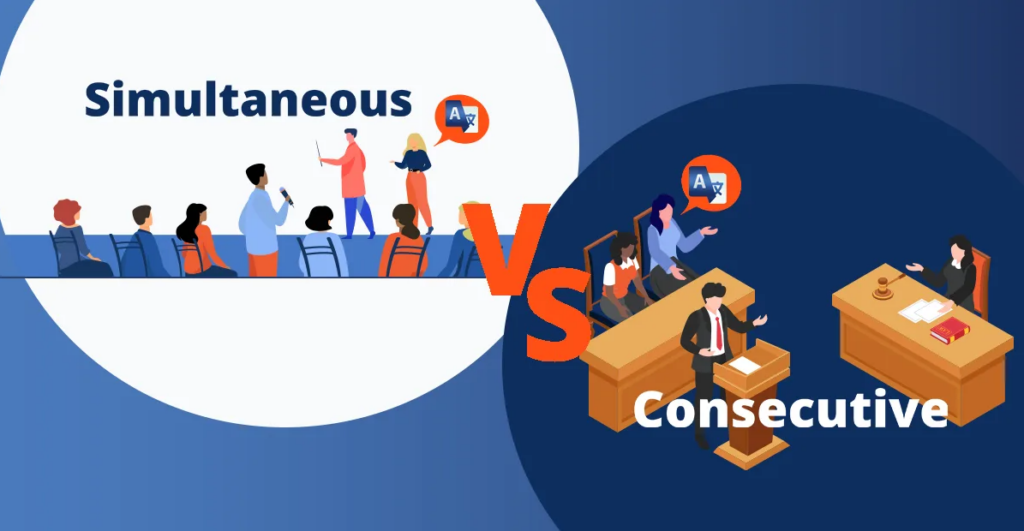
Which is Easier: Simultaneous Interpreting or Consecutive?
This question has no surefire answer. Try asking which race is easier: 400 meters, the mile, or the marathon? What is easier: learning Arabic, Russian, or Chinese?
The “simplicity” of simultaneous lies in the fact that one does not need to memorize much as all is happening in the here and now. Consecutive interpreters are expected to render (interpret) long segments and speeches and to retain much factual information – if they’re to be considered good.
However, consecutive interpreting is not as fast and there is time to think and consider.
Take your pick…
Any true master of interpreting has a skilled command of both.
Is Simultaneous Interpreting as Accurate as Consecutive?
This is by no means a comprehensive statistical analysis, but the author’s off-the-cuff answer is: it depends – depends on the context, on the skill of the interpreter (and their preference), as well as the ambiance and environment.
Historically, consecutive interpreting has been considered more accurate, but many strong simultaneous interpreters (including myself) would dissent. When you’re “in the flow,” I’d say you can render 99.9% of the speech accurately with simultaneous.
Why Can’t I Just Use AI Instead of These Bothersome Interpreters?
Well, you could try… At your own risk. And, I have to admit, with a very clear, comprehensible, enunciating and logical speaker who uses words exactly as they should be used, who doesn’t mentally meander, and so on, it may actually work.
But there are things a human mind can do that a computer mind cannot: things like make judgments as to what is important or not, what the speaker said versus what they meant, knowing when the speaker made a factual mistake, deciding when to interpret an untactful or even obscene statement and when to omit, choosing the right definition and translation of a word that has many of them, etc.
Sure, a computer may have superior command of the terminology that has been stored in its databases. However, any interpreter worth their salt (or pepper) would also prepare this as well and have it stored in their mind, on a piece of paper, or on a computer.
But what a computer cannot do is make human decisions. Truth be told, I sometimes almost have to read the speaker’s mind and interpret their true thought rather than their misphrased idea.
So, simultaneous interpreting software might do a more-or-less decent job, better than a sorry interpreter, but it will never compare with a true magician of interpreting.
Example: one of my friends recorded a clip for his channel where he teaches men about women (a daring undertaking, indeed). But it was even braver on his part to have this video interpreted and voiced over by AI. Sure, it sounded fluent, but there was a crucial mistake:
The Russian word «девушка» has two meanings: a young girl and girlfriend.
The software misinterpreted the term, changing the video’s concept and meaning. Oops. No human interpreter, even a half-decent one, could have possibly made this idiotic mistake.
***
Long story short, simultaneous interpretation requires many mental and linguistic skills. It can be taxing but also fun beyond belief.
And, like anything else, it should be done only by true professionals!
Working with a dilettante can be rough at best and sabotage one’s endeavor at worst. Working with a pro who has flair can make the event flare up like a million stars…
FOR A CONSULTATION ON YOUR EVENT, PLEASE GET IN TOUCH!
Simultaneously yours,
Vladimir