
Interpreting services are often confused with translation, but the two are most definitely not one and the same.
Sure, translation and interpreting have much in common – i.e., accurately conveying the concepts and meanings behind words – but equating the two is like claiming that distance running is sprinting, blitz chess is the same as classical chess, lakes are identical to oceans, boreal forests are no different than tropical, and so forth.
Certainly, translation and interpreting share the same essence – words, meanings, and concepts, but they’re still as different as the ocean and the sky (even if they’re both “blue”).
Translation is slower and tends to be more profound, whereas interpreting is “fast and furious” while still as profound as possible in the circumstances.
In fact, they take a different “breed” of linguist.
TO GET A FREE CONSULTATION ON YOUR PROJECT, PLEASE GET IN TOUCH!
But even within one “realm” – say, interpreting, styles differ greatly. To quote the great Voltaire, “If you would discuss with me, first define your terms.”
Let’s do just that and define the terms related to interpreting services:
Interpreting: the conveying of concepts verbally (or with signs) from one language to another – this includes sign language.
Modes of Interpreting
Consecutive interpreting: waiting for the speaker to finish his or her thought, passage, speech, etc., and only then interpreting it. This is the most common and time-honored form of interpreting that has been around for millennia. It is commonly used during negotiations, various exchanges, Q and A sessions, etc.

Consecutive interpreting requires immaculate attention, a high level of memory retention, skilled notetaking, stage presence, excellent delivery (even more, arguably, than in simultaneous interpreting – because at times your voice has to reach across a vast hall, etc.)
Any truly trained linguist can render 5+ minutes of speech without pausing the speaker (Vladimir’s record is 33 minutes).
No one can be considered a pro if they cannot handle 1-2 minutes.
Using the chess analogy, consecutive interpreting is similar to rapid chess (10-20 minutes per game) – there is time to think but that time is limited.
Simultaneous interpreting: interpreting the speaker without pauses or interruptions. (“Simultaneous” is a slight misnomer because the interpreter almost always follows a few seconds behind the speaker, in order to capture their train of thought). Simultaneous is, to a degree, “the new kid on the block” and has been around for around a century, first officially put into practice at the Nuremberg Trials. This mode can be used in many, many contexts: courts, conferences, escort, even some community interpreting settings (see definitions below).

Simultaneous interpreting is most similar to blitz chess, where you need intuition, instant decision-making, excellent delivery, etc.
Conference Interpreting: basically, a synonym for simultaneous interpreting but applied specifically to interpreting at various conferences, high-level events, the United Nations, etc. This is often done in a booth setting – think “The Interpreter” with Nicole Kidman. Conference interpreting is often considered the paragon of interpreting for the very reason that it is done in extremely responsible contexts and requires an elite level of skill.
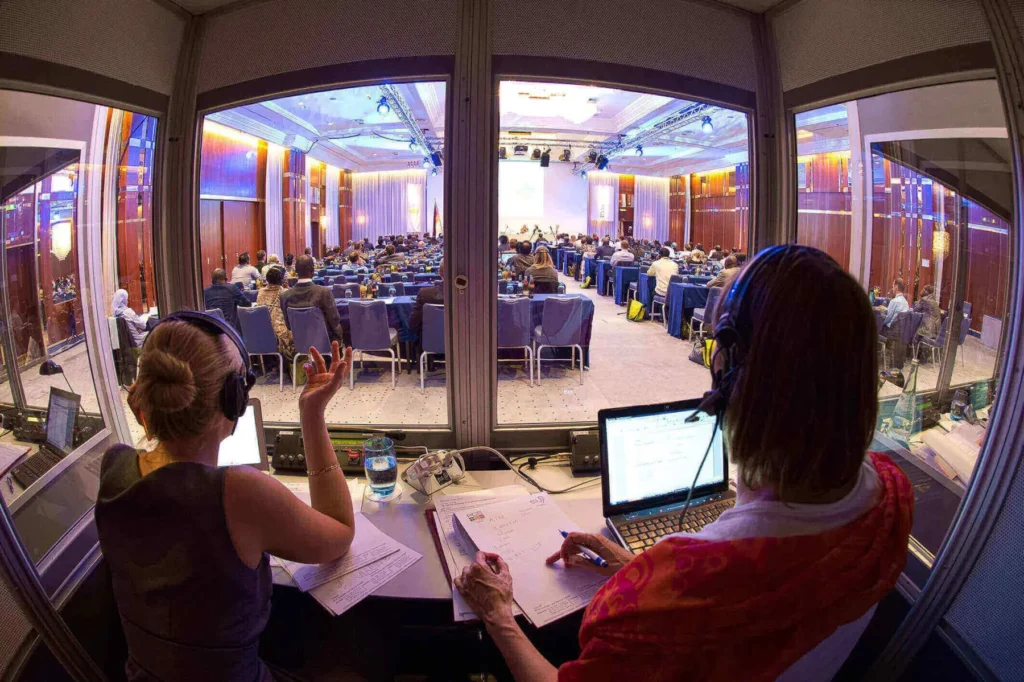
While any interpreting mistake is non-optimum, in diplomacy it can spread like rippling storm waves, affecting millions.
Chuchotage: a form of simultaneous interpreting where the interpreter is not using any equipment but simply whispering into the client’s ear. The word “chuchotage” means “whispering” in French. Chuchotage has the benefit of being simple and needing no equipment, but it is limited to 1-2 people.

Besides all the linguistic skills, this requires expert command of modulating one’s voice as the interpreter is, in essence, whispering in such a way that the client can hear, but no one else will be distracted.
This can be done at events where there is only one client or when no one has officially prepared for simultaneous interpreting.
Sight interpreting (also, sight translation): a mode of interpreting where the linguist is reading a written text yet voicing it verbally. It is the “unsung hero” of interpreting, as it is underused and undertrained (in Vladimir’s not-so-humble opinion).

It is quite helpful in all settings where a document/contract/menu/letter, etc., needs to be understood, but there is no time for written translation. It can even be used to unofficially interpret contracts, books, etc.
Example: a 100-page contract that needs to be understood but would be too long/expensive to translate; or, one wishes to understand a book on one’s profession, the translation of which doesn’t exist.
This skill takes high concentration and practice and is similar to simultaneous in a way. When sight interpreting is practiced with expert skill, the listener will hardly know that it’s a translation.
Curious fact: while translation is considered more precise than interpreting (because there is unlimited time to think and consult resources), any truly professional interpreter will run circles around a poorly trained translator when comparing their sight interpretation and translation.
However, there is no excuse not to use translation for books/documents where a time constraint does not exist, and it should be understood that sight interpreting is not a substitute for translation.
Vladimir has translated several books and a hundred-page contract using this technique.
TO GET A FREE CONSULTATION ON YOUR PROJECT, PLEASE GET IN TOUCH!
Contexts of Interpreting Services
Escort Interpreting: this refers to the interpreter accompanying someone (for example, an entrepreneur or a patient), often in a different country. It can involve all the skills described above. Beyond linguistic skill, a pleasant personality helps, as the linguist and client usually spend more time together than in other contexts.
Court Interpreting: self-explanatory, but this refers to interpreting in court settings. In the U.S., this requires passing a rather rigorous exam, which tests all three modes of interpreting: consecutive, simultaneous, and sight – with a legal bend.
Where states have court-certified interpreters, it is mandatory that they are invited as a first option for trials and hearings, and for good reason – one mistake can cost either of the sides their case.
In most cases and most US states, courts will provide interpreters to non-English speakers free of charge.
Legal Interpreting: similar to but wider than Court Interpreting. This can include depositions, attorney-client meetings, arbitration, etc.
In these settings, it is preferable (and in some cases, mandatory) to use court-certified interpreters.
Diplomatic Interpreting: interpreting as it is applied to diplomatic settings. This usually involves simultaneous and consecutive interpreting. Diplomatic interpreters are the “ghost writers” of politics and play a crucial role in the success of diplomacy. They usually have impeccable command of two or more working languages and, generally, a very impressive and highly polished skill set.
Immigration Interpreting: interpreting related to immigration cases.

In the US immigration courts, special interpreters are used. They are not court-certified, per se, but go through a similar testing process – though not as highly trained, usually.
In USCIS interviews, no standard or certificate is required. However, it is best to use a professional – amateur interpreting can and has led to undesired consequences.
Community Interpreting: interpreting in almost all other settings, like medical, schools, social services, etc. Consecutive interpreting is usually used, and community interpreters are not necessarily expected to command the skill of simultaneous interpreting.
***
Sign Language Interpreting: this can apply to all the above contexts, the only difference being that sign language is used – either the interpreter is going into or out of sign language. Every country has its own sign language, and ASL (American Sign Language) is used in the USA. Sign language interpreting can be simultaneous or consecutive.

Check/monitor “interpreting”: this is not actual interpreting, but rather a quality control process: one interpreter making sure another is doing an accurate and ethical job. This is most often used in legal settings.
***
The modes (styles) of interpreting are only three, really: simultaneous, consecutive, and sight. The rest are variants of the above.
And the other categories (legal, diplomatic, etc.) are contexts where interpreting is applied. All contexts are different and have their own rules, focus, etc., but all use the same basic interpreting fundamentals and skills.
Contrary to popular belief, simultaneous interpreting is not necessarily “harder” than consecutive – it just looks more impressive. (In fact, many professionals prefer to work simultaneously as it is less taxing on one’s memory). Simultaneous and consecutive interpreting are simply distinct skill sets. Running a fast mile is neither easier nor harder than running a fast marathon – they’re simply different.
A true professional is a master of all modes, styles, and settings. One may prefer a certain style over others, but if they’re a pro, they can work in all modes – just like an Olympic swimmer may prefer front crawl, breaststroke, butterfly, or backstroke, but they have a great handle on all styles.
Choosing the right style or mode for your interpreting services simply comes down to understanding the needs and having a profound grasp of the profession.
Vladimir has trained countless interpreters and has worked in nearly all settings: diplomatic, conference, court, negotiations, escort, and so forth.
Note: all interpreting modes in many contexts can, and often are, delivered virtually (by Zoom, etc.), provided that technical arrangements are made for simultaneous interpreting. For example, Vladimir has done Zoom interpretation for Harvard University, countless depositions, arbitrations, etc.
This is quite convenient as the interpreter need not be present. It is possible for someone in the US to help someone in Australia, Ukraine, etc. Clearly, it saves the client money on travel costs for the interpreter.

In some cases, however, the interpreter’s personal presence is much preferred – technical difficulties can be avoided, observing and understanding the speaker are much easier, and, in general, nothing ever beats the personal touch.
As a simple maxim, the more vital the encounter and the more crucial the result, the more desirable it is to have the interpreter physically present – especially when the result of the conversation depends on personal rapport between the parties. (There is a reason why presidents take their interpreters with them).
Examples of Situations When Interpreting Services Are Used
Here are a few situations when a person or an organization might need a professional interpreter (this is by no means an exhaustive list):
- A person is going to court (in this case, a US court should provide the interpreter. All modes can be used)
- A person has an immigration interview (consecutive will usually be used)
- An entrepreneur needs an interpreter for negotiations, conferences, and help in a different country (all modes can be used. This is escort interpreting)
- An academic institution is holding a conference for its colleagues from across the world (conference interpreting, but other styles will occasionally be used for evening events, conversations, etc.)
- Two entrepreneurs are about to “shake on it,” but one asks to read the 22-page contract that has to be signed (sight translation)
- A mom is going to school for a parent-teacher conference and needs to understand the teacher (in the US, the school should provide the interpreter. Consecutive will usually be used, though simultaneous (chuchotage) can be as well)
- A person has a mediation or arbitration by Zoom and needs an interpreter (usually, consecutive is used, but simultaneous can be as well. In the US, the person is usually responsible for contracting the interpreter)
- A person needs to undergo a deposition and needs an interpreter (usually, the lawyer, their assistant, or the person themselves will do this. Consecutive will be used)
- A person is travelling to another country for medical services (escort interpreter, and either consecutive or chuchotage will be used)
TO GET A FREE CONSULTATION ON YOUR PROJECT, PLEASE GET IN TOUCH!
And please, pretty please, work only with true professionals – for your own sake, for the sake of your clients, and the world at large…